|
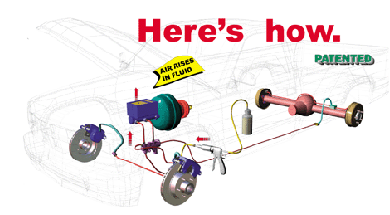
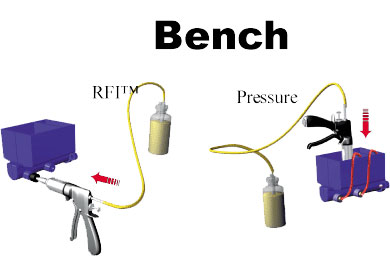
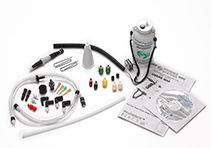
Phoenix Injectors™ can perform all methods of bleeding and flush... RFI™, Vacuum, Pressure & Bench. Check out the methods below, it's incredibly simple RFI... Reverse Fluid Injection or RFI tm injects fluid at the low points of a hydraulic system, the slave bleeder screws on calipers and wheel cylinders. RFI tm takes advantage of the "laws of Physics", that air rises in fluid. A complete brake system is bled by forcing air up and out the master cylinder reservoir.
RFI™ does not require special tools or clips. RFI™ utilizes fluid paths in which enhanced braking mechanisms offer almost no resistance. Metering valves, proportioning valves, and anti-lock valving are designed to manipulate braking pressure, while providing minimal resistance to fluid as it returns to the master cylinder following the release of braking pressure. RFI™ and Contamination "The Phoenix Injector generates less than 10 psi during the RFI™ process. Our testing has shown that this amount of pressure has no chance of forcing contaminates upstream to other brake components. This combined with the fact that the process would be used after the system has been flushed, virtually eliminates any threat." Bill Williams, President WISAT
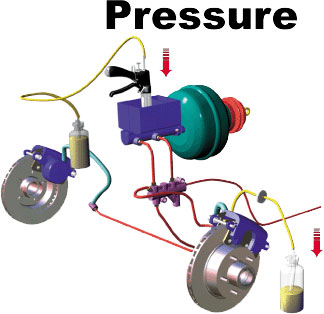
Pressure... During pressure bleeding the fluid in the reservoir is pressurized, via the rubber nose adapter. The pressurized fluid is allowed to pass through the master cylinder and through the metal tubing, eventually arriving at the bleeder valves. When the bleeder valves are opened, the pressurized fluid and most system air will be forced out the bleeder valves. It is recommended the system be RFI bled after a pressure bleed, this assures any remaining air is cleared.
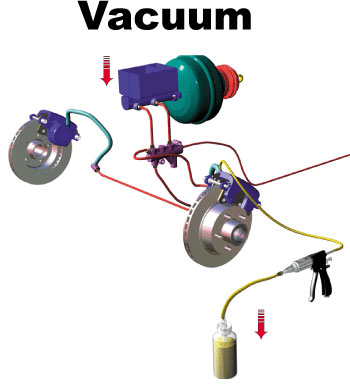
Vacuum... During vacuum bleeding negative pressure is developed in the system by the gun, utilizing each of the bleeder valves. This negative pressure or vacuum draws the fluid from the reservoir (top of system), bringing it through the system until it reaches bleeder valves (bottom of system) where it is expelled.
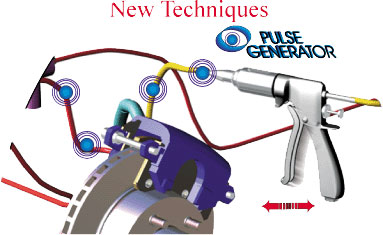
New Techniques Pulse Generator... A technique developed by Phoenix Systems, uses the Injector to create pulsations which generate a force within the system which acts to overcome the surface tension of the trapped air. This Pulse Generation helps to force trapped air out of a system. It’s like tapping on a caliper, slave, master or line, at the same time. A technique developed by Phoenix Systems uses the Injector to create pulsations which generate a force within the system which acts to overcome the surface tension of the trapped air. This Pulse Generation helps to force trapped air out of a system. It's like tapping on a caliper, slave, master or line, at the same time.
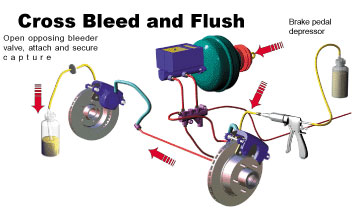
Cross Bleed... When replacing calipers or wheel cylinders on vehicles equipped with a front to rear split hydraulic system you can utilize a cross bleed procedure to remove the majority of the air making the remaining bleed and flush procedure easier. Fluid is injected into a caliper or wheel cylinder to the opposing caliper or wheel cylinder. This will bleed and flush that portion of the hydraulic circuit. A brake pedal depressor is used to prevent the return of fluid to the master cylinder.
|